Design the Defence-Request Form to Fail Early
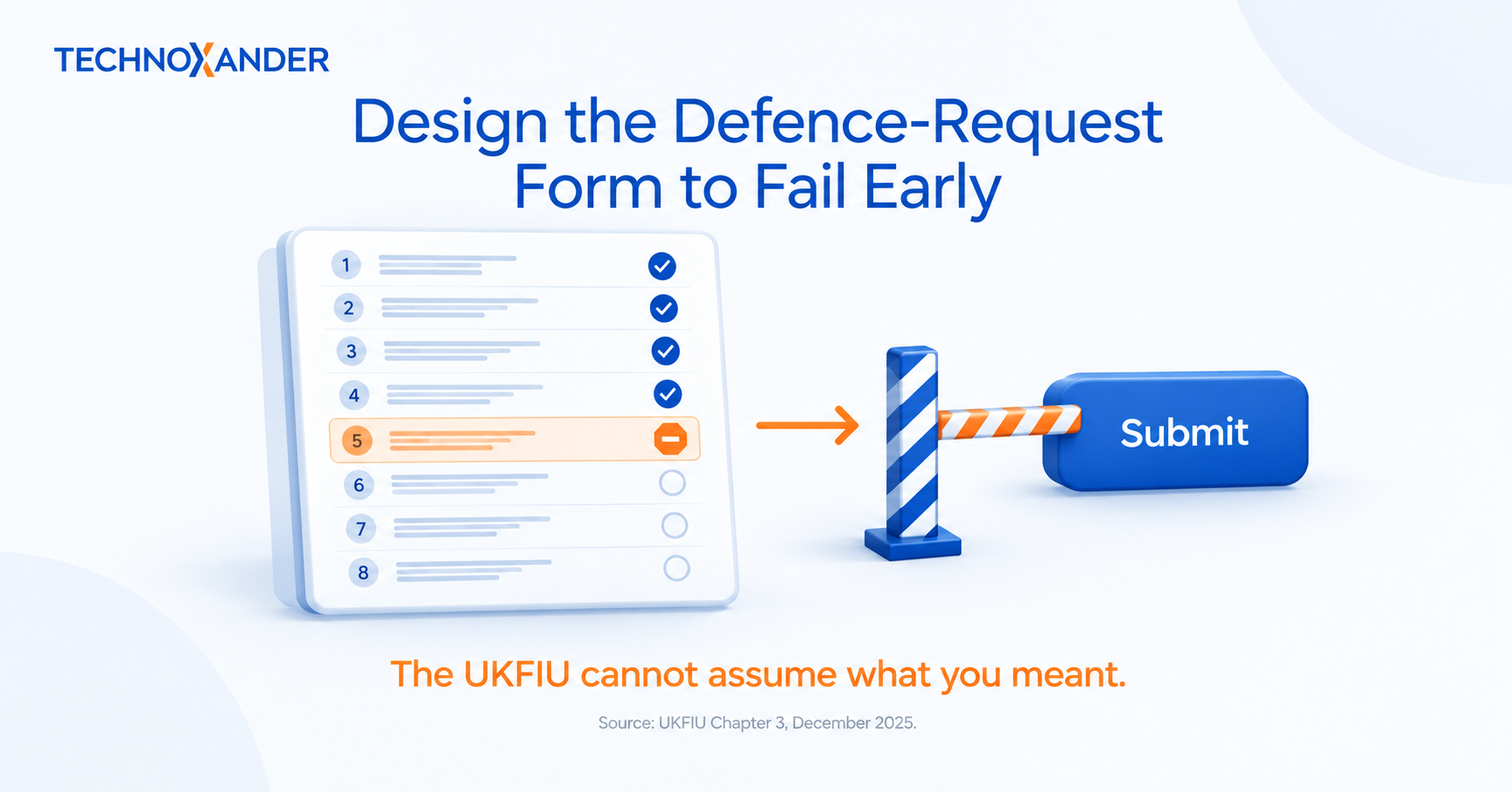
Most compliance forms accept almost anything. The UKFIU does not. If you build the form that investigators use to prepare a defence request, you can catch most problems before the submission, using the UKFIU’s own rules as your validation list.
The principle
The UKFIU says it is unable to interpret, assume or infer anything, so a request has to be clear, explicit and detailed on all three essential criteria. Your form should therefore refuse to let a draft move forward while any criterion is missing.
Eight rules worth encoding
- Grounds for suspicion present. Not empty, and not a copy of the alert rule name.
- Property described. A value, which can be an estimate if marked as one, and a location, or a reason why the location is unknown.
- A single prohibited act. Either/or alternatives are not considered, so the form should accept one act or a clearly set-out series.
- A future date. The date must be in the future and requests cannot be open-ended.
- A time limit. Best practice is that ongoing activity should not exceed 12 months.
- A destination. The UKFIU may not be able to provide a defence if the destination is not known.
- A UK link. Requests without a clear UK nexus cannot be considered.
- Correct legislation selected. Choosing the wrong law may mean you don’t get the defence you need, and the request must be marked as a defence request in the portal’s section 7.
Two things a form cannot check
It cannot tell whether the suspicion is sound, and it cannot tell whether the act is within the firm’s control. The second is a legal condition: the reporter must be able to prevent the act during the notice period or after a refusal. Ask for a human confirmation, not a silent default.
Design cautions
- Do not hide validation errors until the end. Show them as the investigator types.
- Keep wording identical to the SAR Portal’s questions so staff do not translate twice.
- Log what changed between drafts. A narrative that changes late is a signal worth reviewing.
Conclusion
A form that fails early saves days later. For the wider problem of how report quality is decided long before the form opens, see our analysis of SAR quality and the legal defence behind it. If you build these tools, what is the one validation rule you would add that no regulator asks for?
Comments
Join the discussionNo comments yet. Be the first to comment.